PRESENTS
LEGENDS OF THE JUNCTION
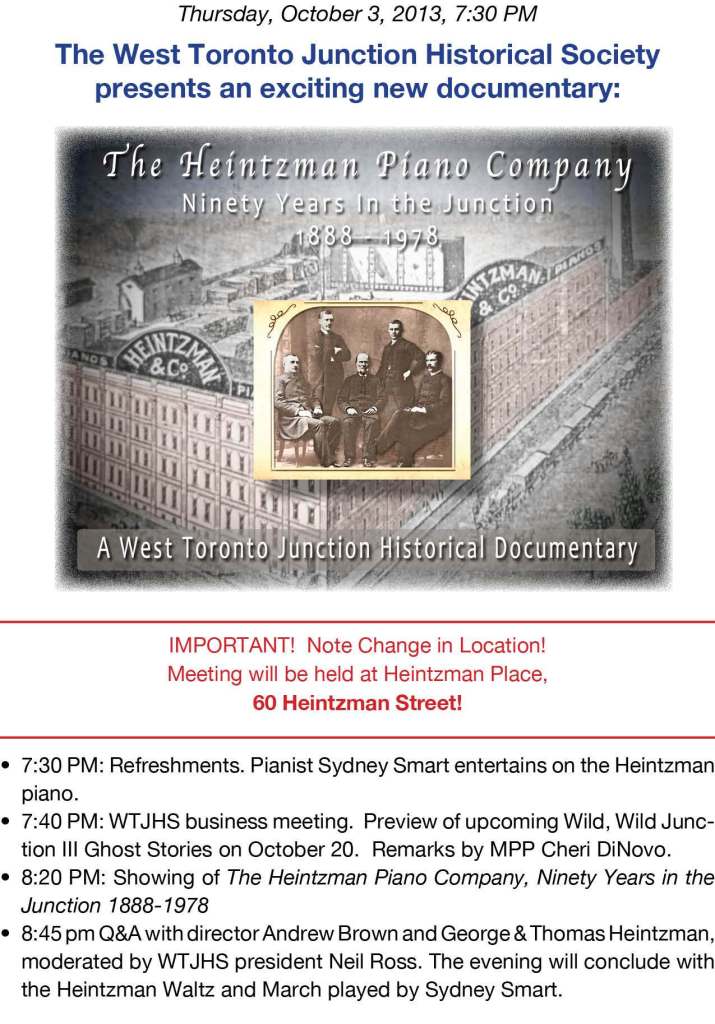
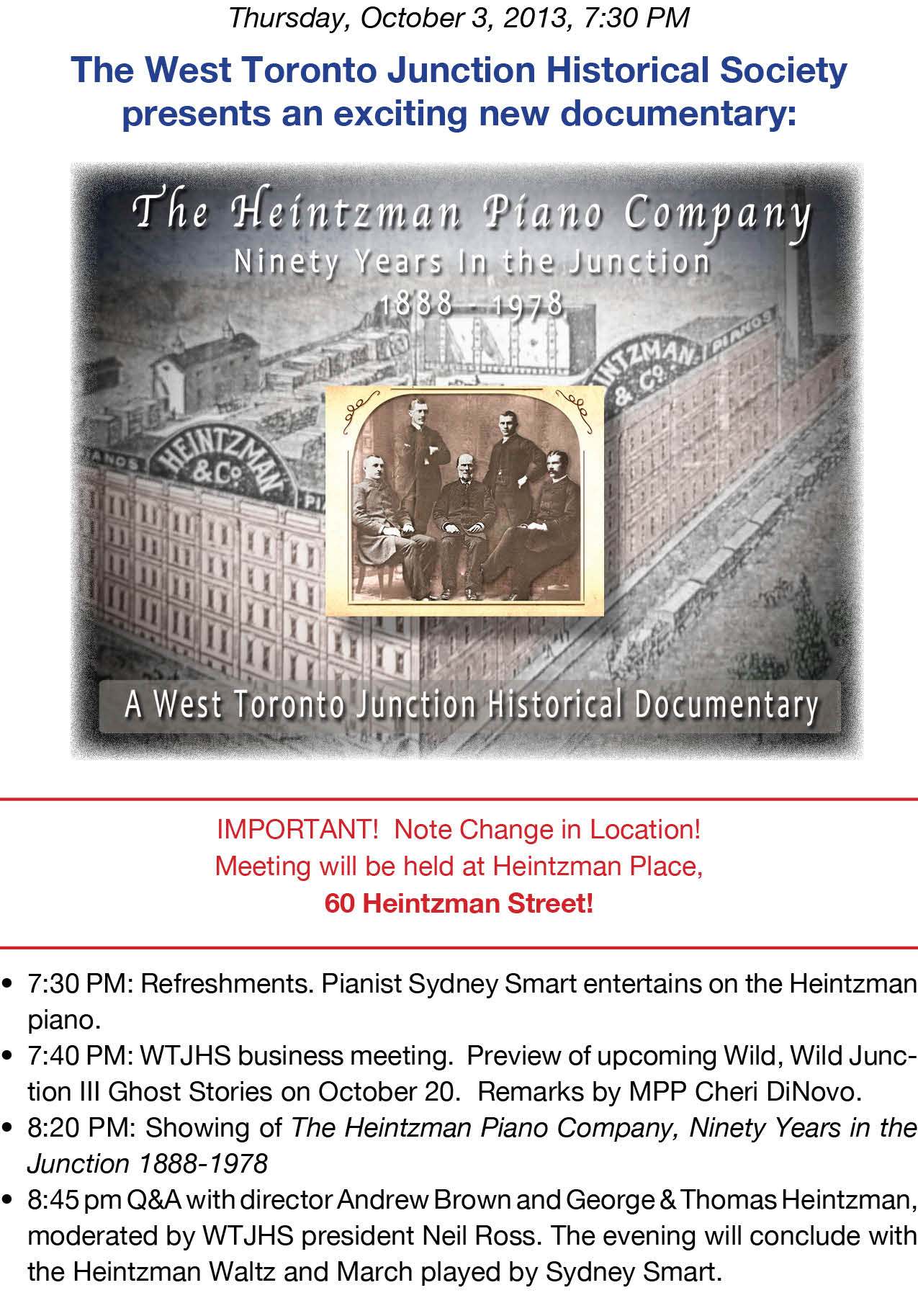
The Heintzman Piano Factory
By David Wencer
People often associate the early Junction with the railway
and stockyards, but the local industry was far more than the roar of the trains
and the bleating of cattle. One of the Junction's primary employers in the
late 19th Century manufactured the era's most popular recreational item: the
piano. Indeed, the Heintzman piano gave Canada an instrument to rival the
famous Steinway. Along with the Junction College of Music, and the Fire House
bell, the Heintzman Piano Factory provided the heart of the Junction with
its musical score.
Theodor Heintzman (born Theodore August Heintzmann) was born and raised in
Berlin, Germany in the early 19th Century. He tried his young hands at various
crafts, but discovered a keen affinity and aptitude for piano construction.
This proved to be prescient - the piano's popularity would only escalate throughout
the century. Heintzman left the factory where he was employed and married
the boss' daughter. Her family soon immigrated to the United States. In 1850,
already approaching middle-age, Theodor Heintzman left for America.
Family legend tells us that Heintzman's ship also bore that other future North
American piano manufacturer, Henry E. Steinway (born Heinrich Steinweg). It
is believed that after settling in New York, Heintzman and Steinweg actually
attempted to go into business together, although any evidence of this venture
has yet to surface. Years later, when both were successful piano-makers, industry
insiders would point out distinct similarities in the two manufacturer's independent
designs. But Heintzman's success was hardly instant.
New York City not to his taste, Heintzman and his family soon relocated to
Buffalo, where he started the "Western Piano Co," which remained
in business for five years. He and his wife now had five adult children: four
sons and a daughter. When his daughter and her husband moved to Toronto, Theodor
and family moved too. This would be the turning point for the family's fortunes.
Theodor was determined to create a successful piano company. Financial constraints
forced him to begin construction in his son-in-law's kitchen. Here his first
four Canadian-made pianos were completed. With the proceeds from their sale,
he was able to open up business as Heintzman & Co. on Toronto's York Street,
soon moving his store to the more advantageous King St., just west Yonge.
Demand for pianos was growing steadily. As financial trends shifted, people
found themselves with increased leisure time, and the piano soon became the
symbol of the Canadian home. In the days before dependable audio recordings,
the piano was the primary means of spreading the emerging entertainment of
popular music. This trend also emerged in the United States and Great Britain.
At the industry's height, Canada was home to over 300 piano different manufacturers.
What made Heintzman's company especially successful was their reputation for
quality. In addition to winning awards at the Canadian National Exhibition,
Heintzman's pianos won acclaim in the United States and overseas. Queen Victoria,
upon hearing a Heintzman piano at Albert Hall, exclaimed "I didn't realize
such beautiful instruments could be made in the colonies."
Heintzman also demonstrated great sales acumen, performing on his own pianos
with great theatricality. But one of his sons, George, is said to have been
the true showman of the family. George took several Heintzman pianos to sell
to the new Dominion, on the first-ever trans-Canadian rail journey. George,
arguably the first man to play a piano across the whole of Canada, then positioned
himself on the cowcatcher when the train pulled into Vancouver, distributing
promotional material.
While the official Heintzman showroom was in downtown Toronto, the primary
factory was one of the first major and lasting industries in the Junction.
Located north of Dundas (until recently the Canadian Tire site and where the
Options for Homes Condominium soon will be), it employed more than 200 craftsmen
at its peak. For its time, it was one of the largest factories of any kind
in Canada, producing 500 pianos a year. The Heintzman showroom, now a Tibetan
Buddhist Temple was said to be the site of many a piano recital featuring
the cream of Junction talent.
Not only was the factory in Toronto Junction, but the majority of the Heintzmans
themselves lived in town. In 1889, Theodor had his primary home, "The
Birches" constructed at the northeast corner of Annette and Laws.
The magnificent Victorian villa remained in the family for many years and
still stands today. Although a developer planned to raze the property in the
early 1980s, the action was fought by the community led by the West Toronto
Junction Historical Society. A compromise was reached wherein the inside was
sold as condominiums, with the outside restored in the original Queen Anne
Revival style. Other houses from the family also remain today, including son
George's home at 23 Woodside.
Theodor died in 1899, leaving the business in the hands of his three surviving
sons. Although Heintzman was considered the last word in upright pianos in
the '20s and '30s, popularity in the piano industry dwindled. Eventually manufacturing
operations were moved up north to Hanover (near Owen Sound), and in the early
1980s, the family ended its association with the company. The name "Heintzman"
still appears on pianos which are made today, although the present-day company
is now a joint Canadian-Chinese operation based out of Beijing.
A few ancestors of the Heintzman family remain in contact with the area, and
Theodor's life has been immortalized by a plaque on the nearby Lutheran Church
he used to attend, as well as by the Junction street which bears his name.
Many homes, schools, and churches across Canada (and indeed around the world)
still maintain Heintzman pianos; manufactured during the glory days, a testament
to one family's superb attention to craftsmanship, a Junction contribution
to everyday Canadian life.